Friday, 2 July 2010

The Visitation of the Blessed Virgin


The Visitation of the BVM commemorates the Visitation made by the BVM to her cousin Elizabeth (c.f. Luke 1: 39-80). The feast originated as a concession to the Franciscans at the request of St. Bonaventure in 1263. Urban VI in 1389 confirmed the celebration of the feast with an Octave on July 2nd. Boniface IX in 1390, the Council of Basle in 1441 and Nicholas V in 1451 confirmed the feast but not the Octave, according to the notes of the Pian Commission. In the 1550 Breviary it became a double feast as it also appeared in the Tridentine Breviary, with a partially new Office in 1569. Clement VIII made the feast a greater double in the 1604 BR and Pius IX made it a double of the second class in 1850. The modern reformers couldn't cope with the feast on the day following the Octave Day of the Nativity of St. John the Baptist finding this illogical and moved it to 31st May. The Byzantines keep the feast, which was only introduced in the nineteenth century, on March 30th.

The feast begins with Mattins (Vespers having been of the Feast of the Precious Blood with a commemoration of the Visitation. (The commemoration at Vespers caused Compline to have Te lucis sung to the melody for the Nativity with the Doxology Jesu tibi sit gloria, Qui natus es de Virgine etc.) The invitatory is proper, Visitationem Virginis Mariae celebremus: Christum ejus Filium adoremus Dominum. The hymn, antiphons and psalms are from the Common of the BVM. In the first nocturn the lessons are taken from the Canticle of Canticles. In the second nocturn the lesson are from a homily of St. John Chrysostom and in the third nocturn the homily is from St. Ambrose on St. Luke's Gospel. The ninth lesson is of SS Processus and Martinian. At Lauds the antiphons Exsurgens Maria etc are sung with the Sunday psalms, the hymn is from the Common, the antiphon on the Benedictus proper. A commemoration is made of SS Processus and Martinian (but not of the Octave of SS Peter and Paul).

At Prime and the Hours the hymns are sung to the melody of the Nativity and with its Doxology. The antiphons from Lauds are sung with the Sunday psalms. At Prime the festal psalms (53, 118i & 118ii) are sung, in the short responsory the versicle Qui natus es is sung, the lectio brevis is In plateis.

Mass is sung after Terce. The Mass Salve sancte parens is sung, the Gloria is sung, in private Masses a commemoration is made of SS Processus and Martinian, the Creed is sung and the preface is of the BVM.

At Vespers the antiphons Exsurgens Maria etc are sung with the psalms from the Common of the BVM. The hymn is Ave, maris stella. A commemoration is sung of the following feast of St. Leo.

In the 'liturgial books of 1962', aka the extraordinary form of the new rite, the ninth lesson of SS Processus and Martinian is supressed. At the Hours the ferial antiphons and psalms are sung, the hymns do not have the Doxology of the Nativity. At Vespers there are no commemorations.

Sunday, 27 June 2010

V Sunday after Pentecost


The fifth Sunday after Pentecost is of semi-double rite. It is also, this year, the Sunday within the Octave of St. John the Baptist. The liturgical colour is green.

At Vespers yesterday the psalms of Saturday were sung. After the collect of the Sunday commemorations were sung of the preceding Office of SS John and Paul and of the Octave of St. John the Baptist. The Suffrage of the Saints was not sung nor were the Dominical preces at Compline because of the occurring double feast and Octave.

At Mattins there are the usual three nocturns. The invitatory and hymn are as last Sunday. In the first nocturn the lessons are the Incipit of the Second Book of the Kings. In the second nocturn the lessons are taken from St. Gregory the Great's Book on Morals. In the third nocturn the homily on St. Matthew's Gospel is from St. Augustine. The Te Deum is sung. At Lauds a commemoration is sung of the Octave of St. John the Baptist. The Suffrage of the Saints is omitted due to the Octave.

At Prime psalms 117, 118i & 118ii are sung. The Dominical preces are omitted due to the Octave.

Mass is sung after Terce. The Gloria is sung, the second collect is of the Octave, there is no third collect - the general rule for Sundays within Octaves. The Creed is sung and the preface is of the Blessed Trinity.

As a result of Pius X moving the feast of St. John the Baptist to the Sunday preceding the feast of SS Peter and Paul in 1911 the rubrics allow for the celebration of the Mass of the feast on the Sunday to which it was formerly attached. All Masses, except the Conventual Mass, may be of St. John the Baptist celebrated in white vestments. The Mass De ventre is sung. The Gloria is sung, the second collect is of the Sunday, the Creed is sung (because of the Sunday), the preface is of the Blessed Trinity and the last Gospel is of the Sunday.

Vespers are of the Sunday with a commemoration of the following feast of St. Irenaeus and of the Octave. The Suffrage of the Saints is omitted at Vespers and the Dominical preces not sung at Compline because of the occurring double feast and Octave.

In the 'liturgical books of 1962' there are no commemorations or Suffrage at Vespers. The Octave of the Great Forerunner has been abolished. Mattins is cut down to one nocturn of three lessons. There are no commemorations or Suffrage at Lauds. At Prime there is neither Quicumque is sung nor the Dominical preces despite there being no commemorated double feast or Octave. Mass has a single collect.

Art: Jerome Nadal

Thursday, 24 June 2010

The Nativity of St. John the Baptist


Today is the great feast of the Nativity of St. John the Baptist. It is a double of the first class with an Octave. The liturgical colour for the feast and Octave is white. The celebration of the feast on June 24th is ancient and is mentioned by the Council of Agde in 506 and in the Martyrologium Hieronymianum. In the 1568 Breviary the feast appears as a double (of the first class) with Octave, the Octave also being found in the various pre-Tridentine uses. In 1911 Pius X moved the feast from the 24th June to the Sunday before the feast of SS Peter and Paul and then, in 1913 restored it to its traditional date. The feast was stripped of its Octave by Pius XII.

In some places a ceremony of the Blessing of Fires in honour of St. John the Baptist takes on the Vigil of the Feast. The Rituale contains a rite of blessing of fire, the newly lit fire being aspersed whilst the Vespers hymn Ut queant laxis is sung. In last Saturday's 'Daily Telegraph' Christopher Howse gave a fascinating glimpse of St. John's Eve in sixteenth century London from the writer John Stow who records that in addition to bonfires at every street corner "every man's door being shadowed with green birch, long fennel, St. John's wort, orpin, white lilies, and such like, garnished upon with garlands of beautiful flowers, had also lamps of glass, with oil burning in them all night; some hung out braches of iron curiously wrought, containing hundreds of lamps alight at once, which made a goodly show, namely in New Fish Street, Thames Street, &c."

The feast began with First Vespers yesterday. The antiphons, Ipse praeibit etc, were proper and sung the psalms of Vespers from the Common of Apostles. The rest of the Office is proper with the hymn Ut queant laxis resonare fibris. The hymn famously rises through a scale in its verses: Ut (Doh), Resonare, Mira, Famuli, Solve, Labii. There were no commemorations at Vespers. Compline of Sunday was sung.

At Mattins the invitatory is proper Regem Praecursoris Dominum, Venite adoremus. The Office hymn is Antra deserti teneris sub annis. The antiphons, psalms and responsories are proper for all three nocturns. In the first nocturn the lessons are taken from the Incipit of the Prophet Jeremiah. In the second nocturn the lessons are from a sermon by St. Augustine on the saints and in the third nocturn the homily is from the writings of St. Ambrose on the first chapter of St. Luke's Gospel. At Lauds the antiphons Elisabeth Zachariae etc are sung with the Sunday psalms. The rest of Lauds is proper to the feast with the Office hymn O nimis felix.

At the Hours the antiphons of Lauds are sung with the Sunday psalms. At Prime (Pss. 53, 118i & 118ii) the lectio brevis is Reges videbunt.

Mass is sung after Terce. The Mass is proper, De ventre. The Gloria is sung, there is only one collect. The Creed is not sung, the common preface is sung. (In the various regional uses of the Old Roman Rite there were proper prefaces for both the Feast and its Vigil e.g. The Missal of Robert of Jumieges.)

At Second Vespers the antiphons sung at Lauds are sung again with the psalms from Vespers for the Common of Apostles. The hymn Ut queant laxis is again sung, the rest of the Office is proper to the feast. A commemoration is sung of the following feast of St. William. At Compline the Sunday psalms are sung.

In the 'liturgical books of 1962' the feast remains relatively unscathed. The antiphons are of course doubled at the Little Hours, Prime has the ferial lection brevis. At Mass there is the addition of the Creed. The Octave has been stripped away.

Those with a liking or interest in the music of Byrd, Gibbons and Hooper may be interested in this recording from BBC's Choral Evensong broadcast from Westminster Abbey yesterday afternoon. The service opens with Gibbons' stunningly wonderful This is the record of John.

Icon: A Russian icon of the Nativity of St. John the Baptist from Wikipedia.

Wednesday, 23 June 2010

Vigil of St. John the Baptist

The Vigil of St. John the Baptist is of simple rite. The liturgical colour is violet.

The Vigil begins with the Office of Mattins and Lauds. At Mattins the invitatory, hymn, antiphons and psalms are taken from the ferial psalter. The last three psalms, or rather three psalm-fragments, are from 'Feria quarta ad Matutinum, in III Nocturno II'. The lessons for the nocturn are proper to the Vigil and are taken from a homily of St. Ambrose on St. Luke's Gospel. The responsories are taken from the Wednesday after the IV Sunday after Pentecost. At Lauds the second schema is sung (a modified form of the ancient ferial Lauds) with psalms 50, 64, 100, Exsultavit cor meum and 145. The versicle and response after the hymn, and the antiphon on the Benedictus are of the Vigil. After the antiphon on the Benedictus has been repeated the Choir kneels and the ferial preces are sung. Following the preces the collect of the Vigil is sung followed by the Suffrage of the Saints.

At the Hours all is taken from the ferial psalter except the collect which is of the Vigil. At Prime psalm 96, displaced from Lauds, is sung after the psalms of Wednesday. The ferial chapter, Pacem et veritatem, is sung as are the Dominical and ferial preces the Choir kneeling. At the other Little Hours the ferial preces are also sung, kneeling.

Mass is sung after None. The ministers wear dalmatic and tunicle. The Mass is proper with the introit Ne timeas, Zacharia. There is no Gloria. The second collect is of the BVM, Concede nos, the third collect Ecclesiae, for the Church or for the pope. Benedicamus Domino is sung as the dismissal.

After Mass the liturgical colour changes as the great feast of the Forerunner begins with First Vespers.

In the 'liturgical books of 1962' the ferial preces are not sung at Lauds or Little Hours. At Prime the fourth psalm is not added, Pacem et veritatem has been abolished so the formerly feastal Regi saeculorum is sung. The Dominical preces are not sung either. At Mass, sung after Terce, there is only one collect and the dismissal is Ite, missa est.

Sunday, 20 June 2010

IV Sunday after Pentecost


The fourth Sunday after Pentecost is the first 'green' Sunday since January 24th (not counting the anticipated fourth Sunday after Epiphany that was celebrated on the Saturday before Septuagesima) so time for sacristans to take out the best sets of green vestments.

At Vespers yesterday afternoon commemorations were sung of the preceding Office of St. Juliana of Falconeri and St. Silverius. The Suffrage of the Saints at Vespers and the Dominical preces at Compline were omitted at because of the occurring double feast.

At Mattins the invitatory is Dominum qui fecit nos and the 'summer' hymn Nocte surgentes is sung. In the first nocturn the lessons are taken from the First Book of Kings. In the second nocturn the lessons are from a sermon of St. Augustine and in the third nocturn from St. Ambrose on the Gospel of St. Luke on the huge catch of fish at the lake of Genesareth. At Lauds a commemoration of St. Silverius is sung followed by the Suffrage of the Saints.

At Prime Quicumque is sung as are the Dominical preces.

Mass is sung after Terce. The Gloria is sung, the second collect is of St. Silverius, the third collect is A cunctis. The Creed is sung and the preface is of the Blessed Trinity.

Vespers are of the Sunday with a commemoration of the following feast of St. Aloysius Gonzaga. The Suffrage of the Saints is omitted at Vespers and the Dominical preces not sung at Compline because of the occurring double feast.

In the 'liturgical books of 1962' both Corpus Christi and the Sacred Heart are considered less important than in previous times and so both feasts have lost their Octaves. Users of the 1962 books have had two 'green' Sundays already. At Vespers there are no commemorations. Mattins is cut down to one nocturn of three lessons. There are no commemorations or the Suffrage at Lauds. At Prime neither Quicumque is sung nor the Dominical preces. Mass has a single collect.

Art: Jerome Nadal

Sunday, 13 June 2010

Sunday within the Octave of the Sacred Heart


Sunday within the Octave of the Sacred Heart, the third Sunday after Pentecost, is of semi-double rite. The structure of the Office is as last Sunday and again the liturgical colour is white. The Gospel pericopes from St. Luke have the parable of the shepherd going after one sheep missing from his hundred strong flock.

At Vespers yesterday afternoon the antiphons and psalms of the feast of the Sacred Heart Suavi jugo tuo etc are sung. The antiphons are not doubled. The chapter is proper to the Sunday, the hymn as on the feast of the Sacred Heart. Commemorations were sung of St. John of St. Facundo, St. Anthony of Padua and the Octave of the Sacred Heart. At Compline Te lucis was sung with the Doxology Jesu tibi sit gloria, Qui Corde fundis gratiam, Cum Patre et almo Spiritu, In sempiterna gloria.

At Mattins the invitatory, hymn, antiphons and psalms are as on the feast of the Sacred Heart but the antiphons are not doubled. In the first nocturn the lessons are a continuation of the First Book of the Kings. The responses are of the Octave. In the second nocturn the lessons are from the Encyclical of Pius XI in 1928 that, inter alia, gave the feast an Octave. In the third nocturn the homily is from St. Gregory on St. Lukes Gospel. At Lauds the antiphons Unus militum etc are sung, as on the feast, with the Dominical psalms. Commemorations are sung of St. Anthony of Padua and the Octave.

At the Hours the hymns have the Doxology Jesu tibi sit gloria etc. The antiphons from Lauds are sung. At Prime the feastal psalms are sung (Pss. 53, 118i & 118ii). In the short responsory the versicle Qui Corde fundis gratiam is sung. The lectio brevis is of the Sunday, Deus autem.

Mass is sung after Terce. The Gloria is sung, the second collect is of St. Anthony, the third collect of the Octave. The Creed is sung, the preface is of the Sacred Heart.

At Vespers the antiphons and psalms of the feast are sung. The chapter is of the Sunday, the hymn of the feast. Commemorations are sung of the following feast of St. Basil, St. Anthony and the Octave.

In the 'liturgical books of 1962' the Octave has gone, having been abolished by Pius XII in 1955. It is an interesting example of discontinuity in successive pontificates. In 1928 Pius XI had instituted a privileged third order Octave for the feast (the last Octave to be created) but his immediate successor removed it along with most of the other Octaves barely a quarter century later. So in the 1962 books today returns to being a green Sunday. At Vespers there are no commemorations. Mattins is stripped down to one nocturn of three lessons. Lauds has no commemorations. Mass has one collect etc.

Friday, 11 June 2010

My newly acquired 1962 Missale Romanum


No, I have not finally flipped and there is no need for a straight-jacket! A parcel arrived on Wednesday morning containing a rather nice set of Monastic Breviaries from 1884 and an interesting, though I would certainly not describe it as nice, altar edition of the 1962 Missale Romanum.

The current game (what would Eric Berne have to say?) played out on a host of 'Traddieland' Blogs of pretending that the 1962 Missale Romanum is somehow 'the ancient Mass', the 'Gregorian Mass', the 'Tridentine Mass', the 'TLM' or 'The Mass of Ages' etc ad nauseam and that its use extended until Paul VI's 1970 Missale Romanum dropped out of a clear blue sky is both highly innacurate and indeed offensive to those of us who value truth and integrity. However, perhaps it is time to look at what happened to the 1962 MR between 1962 and the promulgation of the Novus Ordo Missae by Paul VI in 1969. Over 300 posts on this blog have, generally, looked at how the 1962 rite differs from the rite that preceded it so it may be useful to consider looking briefly at what followed the 1962 rite.

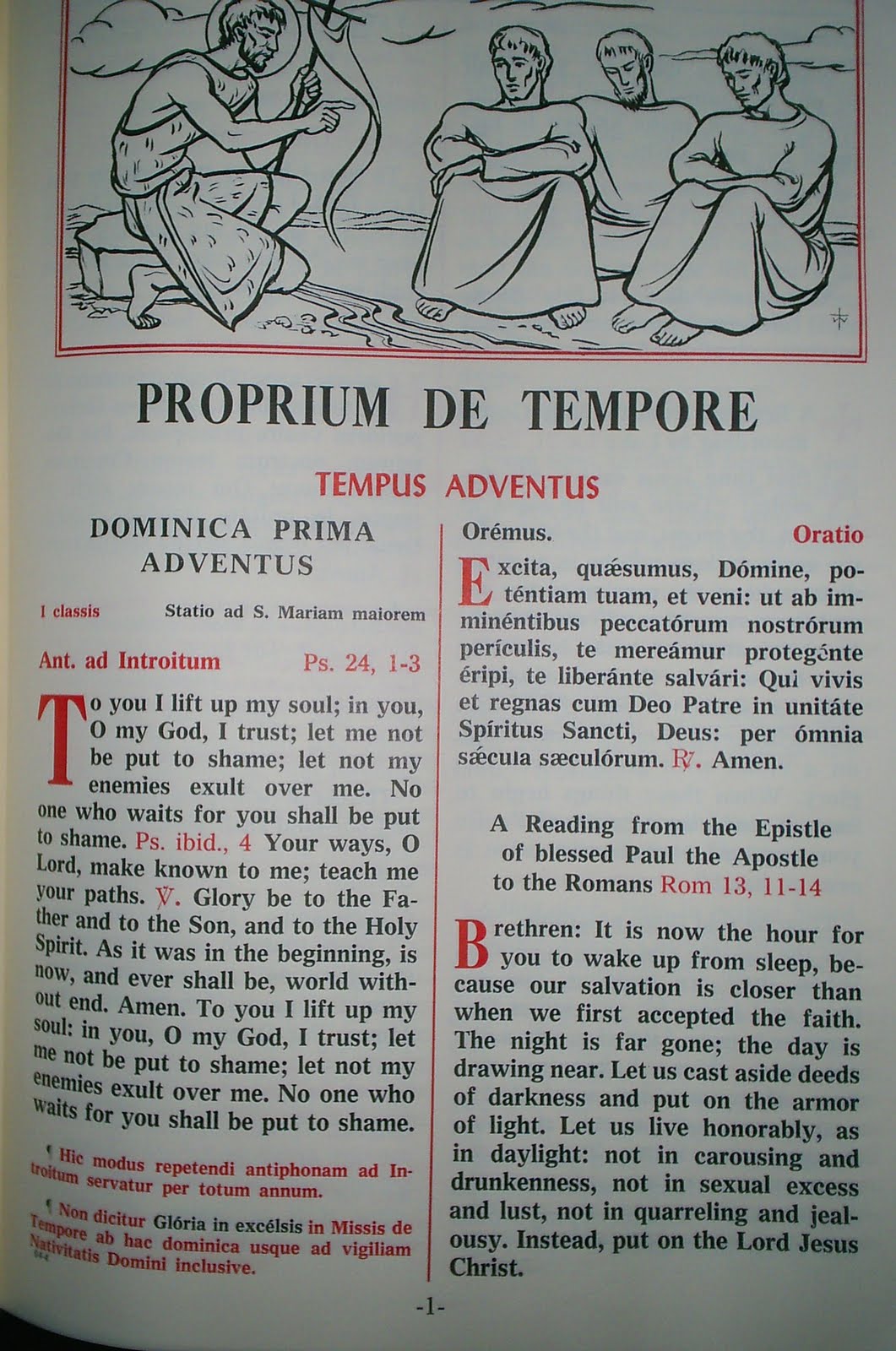
As a starting point let us look at my latest acquistion. It is a 1962 edition of the Missal published in the United States of America in 1964. On the title page, above) the date of publication can be seen. Following this is a Decree from the Episcopal Conference of the USA followed by a decree addressed to the same Episcopal Conference of the USA from the Consilium, Protocol No. 622/64, stating inter alia what parts of the Mass may be celebrated in the vernacular. Interesting to note the familiar name of the Secretary. Then one finds Quo primum, Cum sanctissimum, Si quid est, Rubricarum instructum and Novum rubricarum, the 1962 rubrics etc.


After the usual contents turning of the pages brings one to the First Sunday of Advent. This is what one finds:


Note that the introit, re-named 'antiphon at the introit' in the 1962 MR (the term used for the first time in the Ordo Hebdomadae Sanctae Instauratus in 1956) and later books, is in English. The collect and other orations remain in Latin but the Epistle, Gradual, Alleluia, Gospel, 'antiphon at the offertory' and 'and antiphon at communion' are also in the vernacular.


Turning to the Ordo Missae one finds Judica me and Psalm 42 in Latin. Judica me, as we shall see in subsequent posts, was cut for all days in the '1965' rite but its inclusion here indicates this is a 1962 edition of the Missal. However, turning the page one finds the Kyrie and Gloria in English.


Then the introduction to the proclamation of the Gospel is also in English as is the Creed. All is then back in Latin until the Sanctus.


The Canon remains in Latin but the Pater noster, Agnus Dei, dismissal and blessing are in English.


So here we have an example of a 1962 Missal which has seen a significant number of texts vernacularised but with no other structural changes. It seems the 'Mass of Ages' would be better described as the Mass of the Age. Later in 1964 came the next stage of the reform which structurally altered the Ordo Missae, and much more besides. This will be discussed in further posts.

As to this edition of the 1962 MR it will be joining its stable mates firmly upside-down on my shelves.