The only surviving set of red hue is the fullest and, perhaps, the finest of the extant vestments. The set is complete. The chasuble is of a noticeably fuller cut than the others and its back must have fallen almost to the feet of Dr. Fortesuce. Whilst describing it as 'red' I am not convinced that it actually was used for the feasts of Apostles and Martyrs or for Pentecost. The ground fabric is shot silk of crimson and violet that gives a deep crimson-plum colour. The orfreys are the finest of the extant vestments and consist of a pattern of rose stems edged in silver thread, complete with silver thorns. The stems are filled with embroidered dark purple thread and decorated with roses that are detailed in silver and embroidered with purple, violet and red silk.
Dr. Fortescue delivered a paper on vestments to the Westminster Cathedral Altar Society in February 1912. This paper is available on line The Vestments of the Roman Rite. In that published paper there are some (poor quality) images and Fig. 1 (p.10) shows some of Dr. Fortescue's stoles. From the extant vestments it is clear that at least three sets have ended up in land-fill or have been lost. Dr. Fortescue describes a scarlet-red set so it is clear at least one red set existed and may suggest the vestment featured in this post was not used as 'red'. Whether it was actually a rose vestment (the relative lack of use might explain its degree of preservation) or a Passiontide vestment is a question I would leave to experts in vestiture.
Friday, 9 December 2011
Thursday, 8 December 2011
The Vestments of Adrian Fortescue, DD - Part IV
Two black chasubles survive of Dr. Fortescue's vestments. One set, of black silk lined with blue, is decorated with blue orfreys and silver details. The silk of the chasuble is decaying and the lining can be seen showing through in some places. The second chasuble is completely black but utilises different materials, black silk and black velvet, to decorative effect. This set is incomplete.
Note the narrow, parallel lines, of the maniple. No 'spade' maniples for Dr. Fortescue.
Wednesday, 7 December 2011
The Vestments of Adrian Fortescue, DD - Part III
Only one green vestment survives. During Dr. Fortesuce's, sadly short, life the major reform of 1911-13 took place with the noticeable result of 'green' Sundays being celebrated in the period after the Octave of the Epiphany to Septuagesima and from the Octave of Corpus Christi to Advent. Prior to the reform, with a heavily congested calendar, the vast majority of these Sundays would have been double feasts of Saints and celebrated in white or red vestments. We will probably never know how many green sets of vestments Dr. Fortescue had.
The surviving green vestment has been designed in a similar style to that of one of the violet sets with a 'Tau' cross orfrey. As in that violet set, one of the white and the rose vestment the orfrey is of velvet in a matching colour to the ground fabric. The silk of the green vestment contains a pattern with small birds (see the last photograph for detail). The woven braid of the violet and green sets consists of alternating black and white small panels. The violet sets have these panels in both rectangular and parallelogram shapes. The braid on the green set is composed of parallelograms of alternating black and white panels.
Detail of the stole (above and below photographs).
Tuesday, 6 December 2011
The Vestments of Adrian Fortescue, DD - Part II
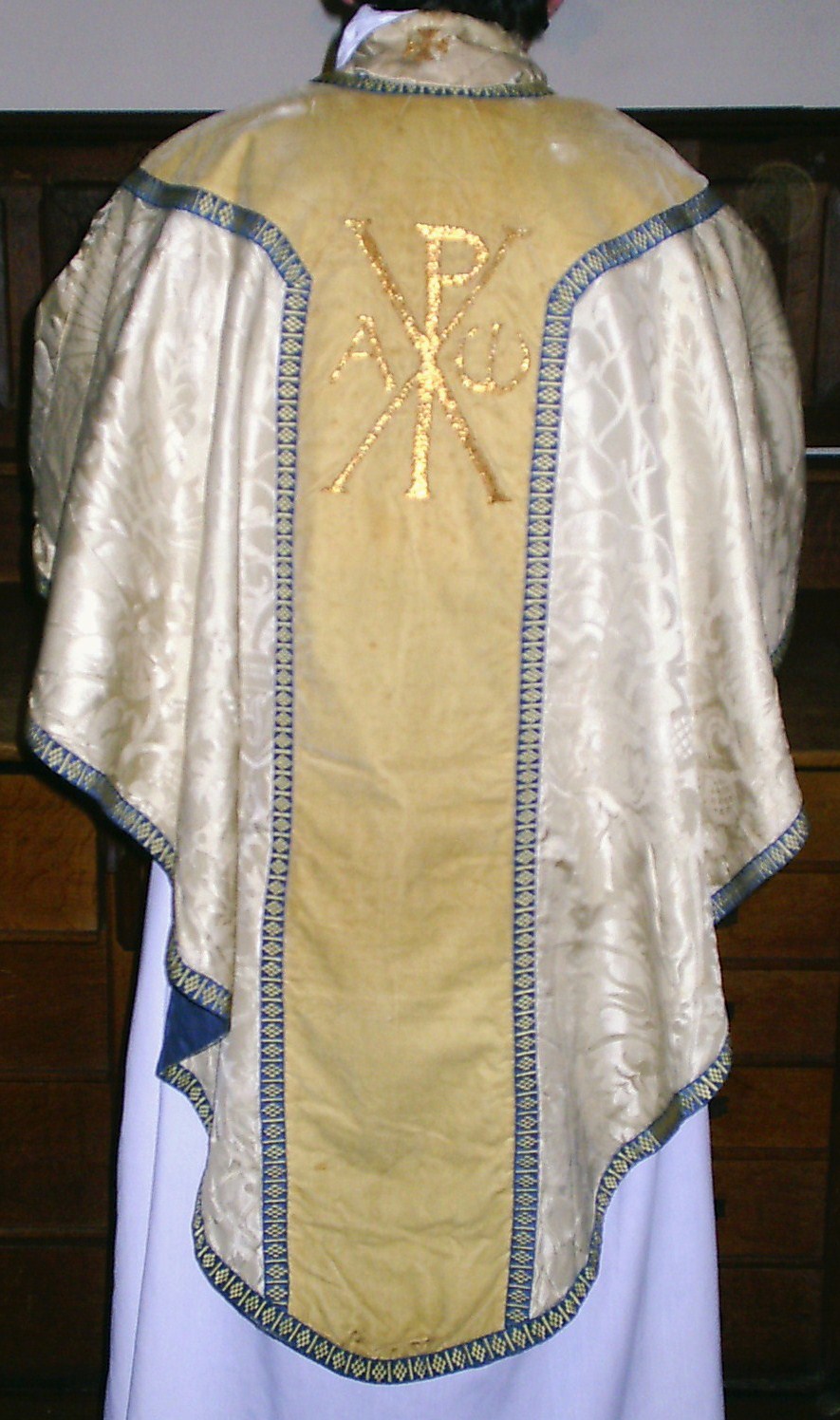
There are two extant white sets of vestments designed and used by Dr. Fortescue. Both sets have more of their constituent pieces than the violet sets of yesterday's post. The second white set below has a wide velvet silk orfrey (now showing some discolouration), a combination shared with several of the other vestments in the different liturgical colours. The detail in the orfreys of both sets is very fine and carefully designed.
The above is a photograph of the end of the maniple resting on the chalice veil. Note the width (and length from the photographs above) of the maniple. The second set, below, is showing signs of deterioration of the velvet column. Again note the length of the maniple and the stole.
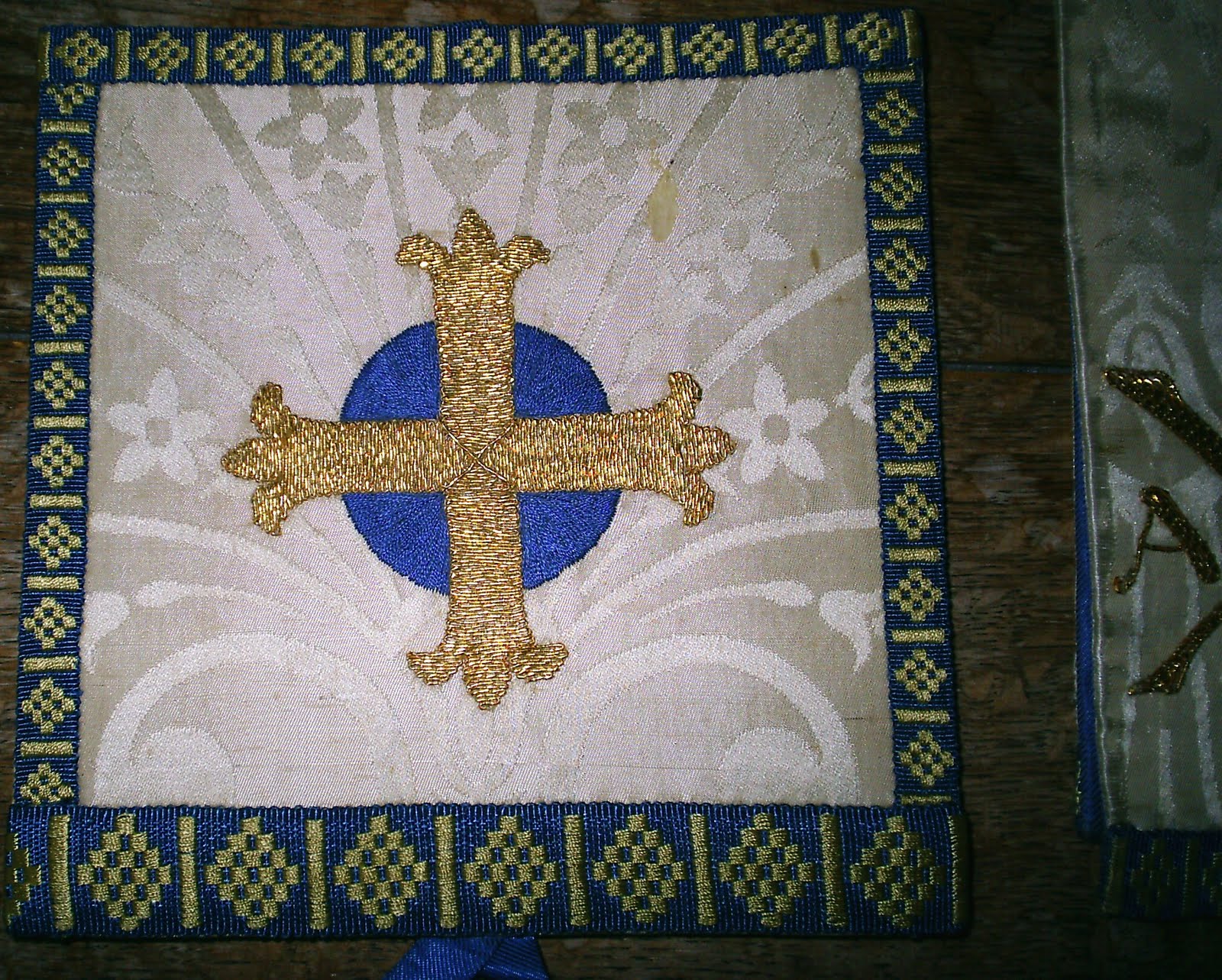
The Chi-Rho decoration at the termination of the stole and maniple, and the cross on the burse are of embroidered gold thread.
The above is a photograph of the end of the maniple resting on the chalice veil. Note the width (and length from the photographs above) of the maniple. The second set, below, is showing signs of deterioration of the velvet column. Again note the length of the maniple and the stole.
The Chi-Rho decoration at the termination of the stole and maniple, and the cross on the burse are of embroidered gold thread.
Monday, 5 December 2011
The Vestments of Adrian Fortescue, DD. Part I
This month will see the launch of a new biography of one of the most brilliant yet enigmatic of English clerics, Dr. Adrian Fortescue. 'The Latin Clerk: The Life, Work and Travels of Adrian Fortescue' by Aidan Nichols OP and published by the Lutterworth Press should, hopefully, be an interesting read. Adrian Fortescue was a man of many, diverse, talents and there is a certain irony that the work which most readers of this blog will associate him with, The Ceremonies of the Roman Rite Described, was a work Fortescue deeply regretted writing and took little subsequent interest in. That in itself is rather sad as it is a most excellent work indeed.
Fortescue designed his own vestments in a singular yet characteristic style for use at his church of St. Hugh at Letchworth. Several years ago with a change of incumbent Fortescue's vestments were thrown away and piled onto a skip. Fortunately, some were spared the land-fill site and rescued from the skip by His Excellency Fra' Duncan Gallie and taken to St. Edmund's College at Ware, an institution with which Dr. Fortescue had many connections. Two years ago I was able to take some photographs of them thanks to the kindness of Mr. Alan Robinson. Several Low Mass chasubles, some complete sets, were saved along with a frontal of great interest but, sadly, no copes or High Mass sets survive.
As this is the season of Advent this first post will show the violet vestments. Two violet Low Mass chasubles remain. One has maniple, burse and veil the other only its stole. As the adage says 'a picture is worth a thousand words' let the vestments describe themselves.
Sunday, 4 December 2011
The Second Sunday of Advent
The second Sunday of Advent (and the third and fourth) are semi-doubles of the second class in rank. The Gospel pericopes, from St. Matthew, tell of St. John the Baptist in prison sending two of his followers to meet the LORD. The liturgical colour is violet and, as folded chasubles are worn, the organ is not played.At Vespers on Saturday the proper antiphons from today's Lauds were sung, Ecce in nubibus caeli etc, with the psalms of Saturday. The Office hymn was Creator alme siderum. After the collect of the Sunday commemorations were sung of the preceding Office of St. Francis Xavier then of St. Peter Chrysologus and St. Barbara. At Compline the Dominical preces were omitted because of the occurring double feasts.
At Mattins the invitatory is Regem venturum and the Office hymn is Verbum supernum. In the first nocturn the antiphons Veniet ecce Rex etc are sung with the usual psalms for Sunday. The lessons are a continuation of Isaiah and today contain the beautiful symbolism of the Rod of Jesse. In the second nocturn the antiphons Gaude et laetare etc are sung and the them of the Rod of Jesse is continued as the lessons are taken from St. Jerome's Expositon on Isaias the Prophet. In the third nocturn the antiphons Gabriel Angelus etc are sung and the homily is from St. Gregory. The Te Deum is omitted and in its place a ninth responsory, Ecce Dominus veniet, is sung.
At Lauds the antiphons, Ecce in nubibus caeli etc are sung with the Sunday psalms. The hymn is En clara vox. After the collect of the Sunday commemorations are sung of St. Peter Chrysologus and St. Barbara. At Prime the Dominical preces are omitted due to the occurring double feast.
Mass is sung after Terce, the deacon and subdeacon wear violet folded chasubles. The Gloria is not sung. The second collect is of St. Peter Chrysologus, the third collect of St. Barbara. The Creed is sung and the preface is of the Trinity. Benedicamus Domino is sung as the dismissal by the deacon facing the altar.
At Vespers the antiphons from Lauds, Ecce in nubibus caeli, are sung with the usual Sunday psalms. The Office hymn is Creator alme siderum. After the collect of the Sunday commemorations are sung of St. Peter Chrysologus and St. Sabbas. At Compline the Dominical preces are omitted due to the double feast.
In the 'liturgical books of 1962' there are no commemorations at either Vespers. The Dominical preces are always omitted at Prime and Compline. Mattins is cut down to one nocturn of three lessons. At Lauds there are no commemorations. At Mass the ministers wear dalmatic and tunicle, there is only one collect and the dismissal is Ite, missa est.
Art: Jerome Nadal
Friday, 2 December 2011
Update: Orders for Ordines
Several batches of Ordines have been posted this week. Having had 'flu for two weeks earlier in November this has caused some delay but I am now catching up with the backlog of orders.
Your patience would be much appreciated.
Subscribe to:
Posts (Atom)