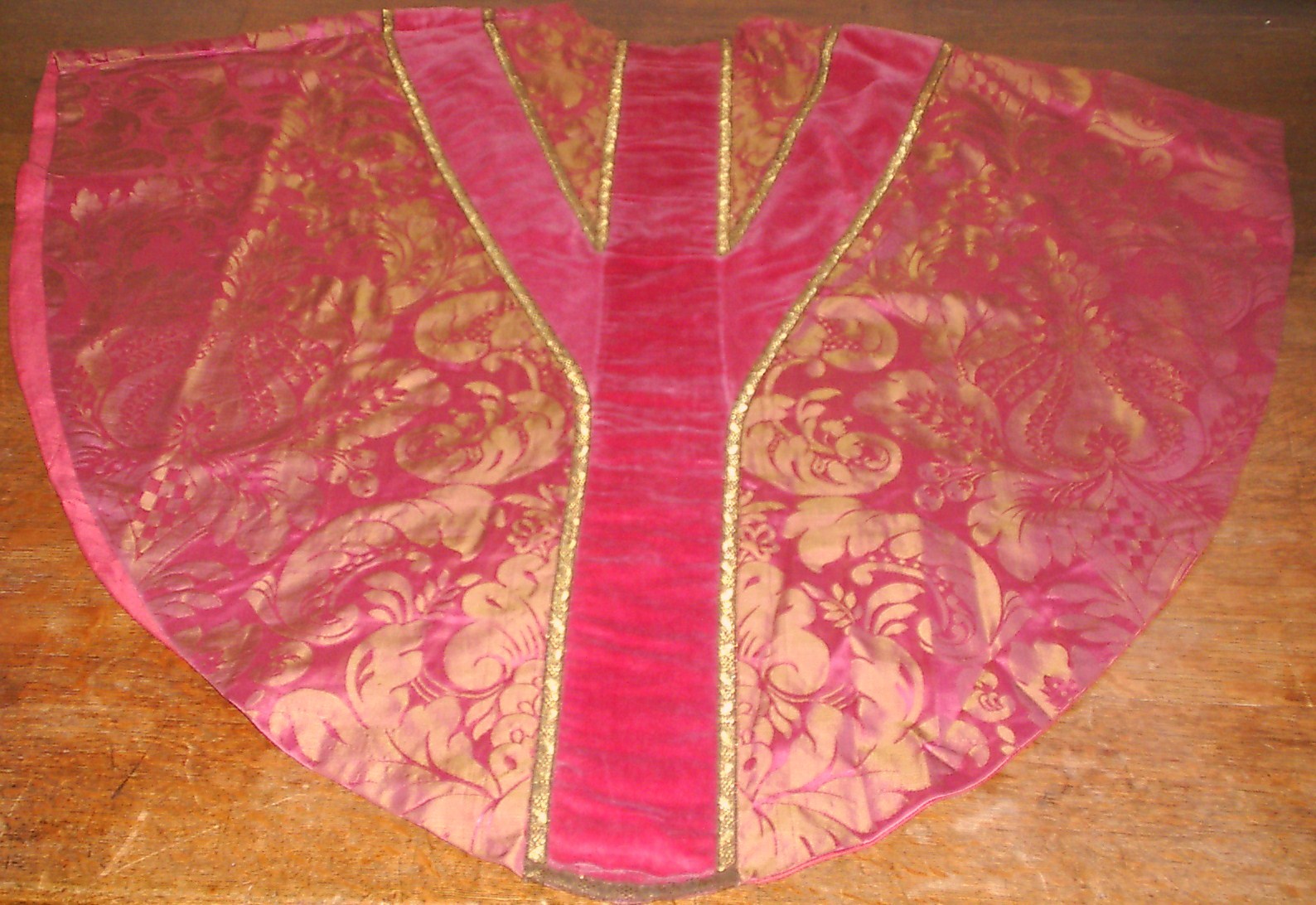
The cope follows the same style as the red cope with a patterned silk ground and velvet orphreys for contrasting texture. The orphreys are edged with braid details. At the front there is, again, a simple clasp. The hood is of velvet, with braid details and lined with rose silk. The hood is fully functional.
Showing posts with label Fortescue. Show all posts
Friday, 16 August 2019
Some further Vestments of Adrian Fortescue, D.D. - Part III
The extant rose cope is of similar design to the green and red vestments described below. The condition of the rose cope is, perhaps surprisingly, intermediate between that of the red and green copes. Whilst intact there is some fading of both silk and velvet.
Friday, 2 August 2019
Some further Vestments of Adrian Fortescue, D.D. - Part II
As with the green cope the surviving red cope is of simple design of a patterned silk ground with contrasting velvet orphreys edged with braid details. At the front there is a simple clasp. The hood is of velvet, with braid details and lined with red silk. The hood is fully functional.
The red cope is in significantly better condition than the green one with no visible signs of decay.
Thursday, 18 July 2019
Some further Vestments of Adrian Fortescue, D.D. - Part I
Having written back in 2011 that no copes or High Mass sets survived from Dr. Fortescue's collection of vestments for his church of St. Hugh it was a pleasure to be corrected and to learn that some copes are still extant - but certainly no High Mass sets. Again I am most grateful for the kindness of Mr. Alan Robinson for assistance in photographing the copes and for his insightful knowledge of matters liturgical.
Four copes green, red, rose and white survive along with a humeral veil. Also a green stole, with no matching items, with asymmetric decoration which was not considered in the earlier series eight years ago.
The clasp on the green cope is relatively ornate and part of it may have contained a decorative semi-precious stone or piece of polished glass judging by the shape of the terminal.
Four copes green, red, rose and white survive along with a humeral veil. Also a green stole, with no matching items, with asymmetric decoration which was not considered in the earlier series eight years ago.
All of the four copes are of a similar design of silk body with contrasting velvet orphreys edged with braid details. The hoods are all fully functional - typically Fortescue who disliked function being reduced to mere decoration. The green cope is in the fragile condition with the silk decaying along the seams and overall fading of the silk.
The copes must have almost touched the ground when Dr. Fortescue wore them.
The hood can be worn and is lined with green silk.
The clasp on the green cope is relatively ornate and part of it may have contained a decorative semi-precious stone or piece of polished glass judging by the shape of the terminal.
Sunday, 11 December 2011
The Vestments of Adrian Fortescue, DD - Part VII
On Gaudete Sunday it seems appropriate to end this series of posts with a rose set of vestments of Dr. Fortescue.
The set is complete and in good condition. The cut of the chasuble is similar to that of the first violet set, the chauble modelled on that of St. Thomas of Canterbury at Sens, but a slightly fuller in cut. The ground material is a deep rose silk with golden ornamentation. It has a 'Tau' cross silk velvet orfrey to its front and rear. The orfreys are edged with gold braid. The chasuble is still in regular use.
Above: Detail of the chalice veil and stole. Again note the narrowness and length of this splendid vestment. Below: the burse.
The set is complete and in good condition. The cut of the chasuble is similar to that of the first violet set, the chauble modelled on that of St. Thomas of Canterbury at Sens, but a slightly fuller in cut. The ground material is a deep rose silk with golden ornamentation. It has a 'Tau' cross silk velvet orfrey to its front and rear. The orfreys are edged with gold braid. The chasuble is still in regular use.
Above: Detail of the chalice veil and stole. Again note the narrowness and length of this splendid vestment. Below: the burse.
Saturday, 10 December 2011
The Vestments of Adrian Fortescue, DD - Part VI
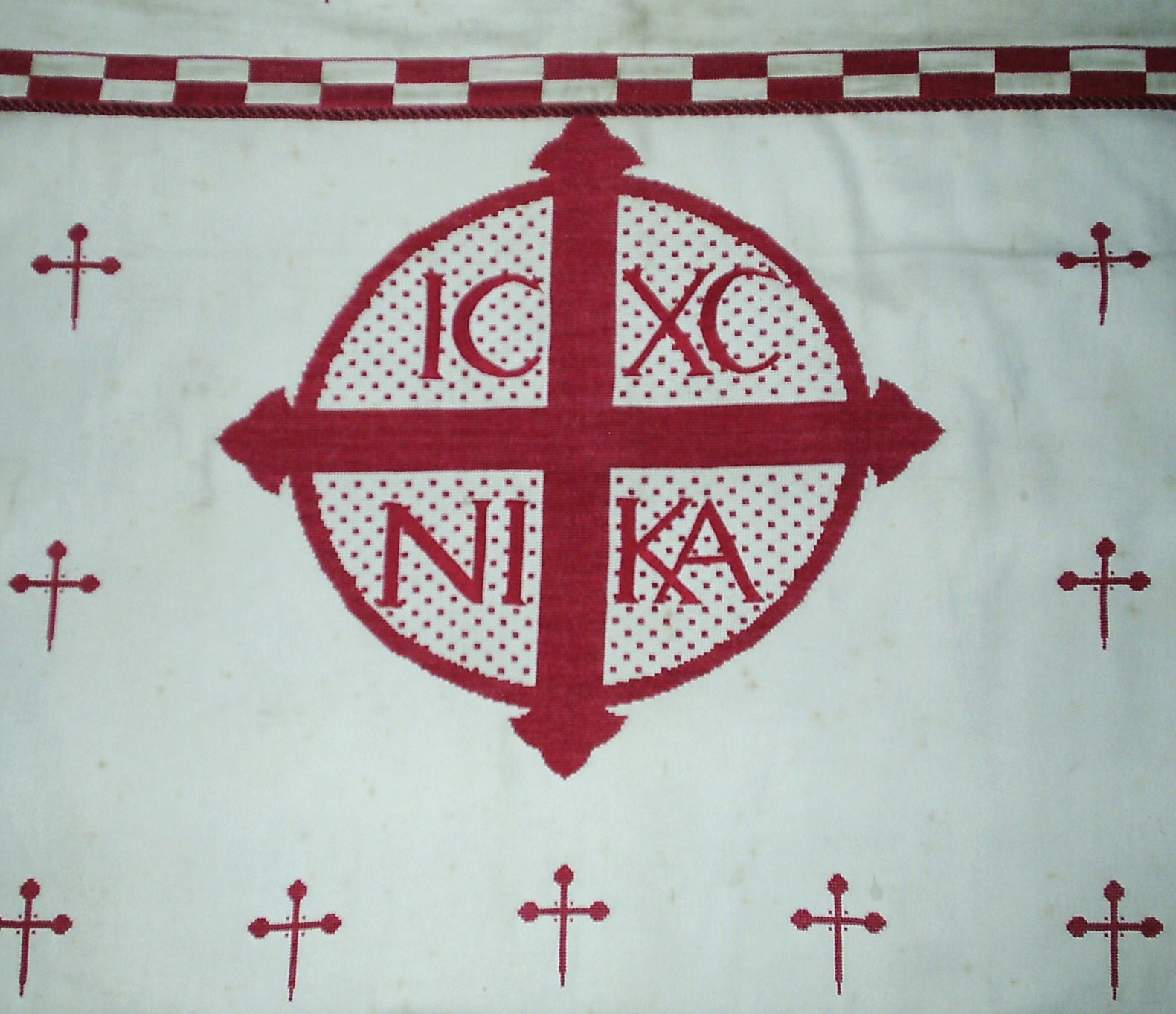
The only extant altar frontal designed by Dr. Fortescue is very striking. In his 1912 paper (Fig 3, p.15) Dr. Fortescue describes it as 'white canvas with embroidered scarlet silk'. The image from the paper is below:
However, looking at the frontal it strikes anyone familiar with North European Lenten custom as a rather beautiful modern example of Lenten Array. From Ash Wednesday the brightly coloured interiors of churches were covered with Lenten Array or Lenten 'White' the idea of which was to exclude colour until the joy of the Resurrection. Examples of modern array can be seen on the beautiful blog Vitrearum's Church Art.
The frontal is now stained in several places but overall in good condition.
However, looking at the frontal it strikes anyone familiar with North European Lenten custom as a rather beautiful modern example of Lenten Array. From Ash Wednesday the brightly coloured interiors of churches were covered with Lenten Array or Lenten 'White' the idea of which was to exclude colour until the joy of the Resurrection. Examples of modern array can be seen on the beautiful blog Vitrearum's Church Art.
The frontal is now stained in several places but overall in good condition.
Friday, 9 December 2011
The Vestments of Adrian Fortescue, DD - Part V
The only surviving set of red hue is the fullest and, perhaps, the finest of the extant vestments. The set is complete. The chasuble is of a noticeably fuller cut than the others and its back must have fallen almost to the feet of Dr. Fortesuce. Whilst describing it as 'red' I am not convinced that it actually was used for the feasts of Apostles and Martyrs or for Pentecost. The ground fabric is shot silk of crimson and violet that gives a deep crimson-plum colour. The orfreys are the finest of the extant vestments and consist of a pattern of rose stems edged in silver thread, complete with silver thorns. The stems are filled with embroidered dark purple thread and decorated with roses that are detailed in silver and embroidered with purple, violet and red silk.
Dr. Fortescue delivered a paper on vestments to the Westminster Cathedral Altar Society in February 1912. This paper is available on line The Vestments of the Roman Rite. In that published paper there are some (poor quality) images and Fig. 1 (p.10) shows some of Dr. Fortescue's stoles. From the extant vestments it is clear that at least three sets have ended up in land-fill or have been lost. Dr. Fortescue describes a scarlet-red set so it is clear at least one red set existed and may suggest the vestment featured in this post was not used as 'red'. Whether it was actually a rose vestment (the relative lack of use might explain its degree of preservation) or a Passiontide vestment is a question I would leave to experts in vestiture.
Thursday, 8 December 2011
The Vestments of Adrian Fortescue, DD - Part IV
Two black chasubles survive of Dr. Fortescue's vestments. One set, of black silk lined with blue, is decorated with blue orfreys and silver details. The silk of the chasuble is decaying and the lining can be seen showing through in some places. The second chasuble is completely black but utilises different materials, black silk and black velvet, to decorative effect. This set is incomplete.
Note the narrow, parallel lines, of the maniple. No 'spade' maniples for Dr. Fortescue.
Wednesday, 7 December 2011
The Vestments of Adrian Fortescue, DD - Part III
Only one green vestment survives. During Dr. Fortesuce's, sadly short, life the major reform of 1911-13 took place with the noticeable result of 'green' Sundays being celebrated in the period after the Octave of the Epiphany to Septuagesima and from the Octave of Corpus Christi to Advent. Prior to the reform, with a heavily congested calendar, the vast majority of these Sundays would have been double feasts of Saints and celebrated in white or red vestments. We will probably never know how many green sets of vestments Dr. Fortescue had.
The surviving green vestment has been designed in a similar style to that of one of the violet sets with a 'Tau' cross orfrey. As in that violet set, one of the white and the rose vestment the orfrey is of velvet in a matching colour to the ground fabric. The silk of the green vestment contains a pattern with small birds (see the last photograph for detail). The woven braid of the violet and green sets consists of alternating black and white small panels. The violet sets have these panels in both rectangular and parallelogram shapes. The braid on the green set is composed of parallelograms of alternating black and white panels.
Detail of the stole (above and below photographs).
Tuesday, 6 December 2011
The Vestments of Adrian Fortescue, DD - Part II
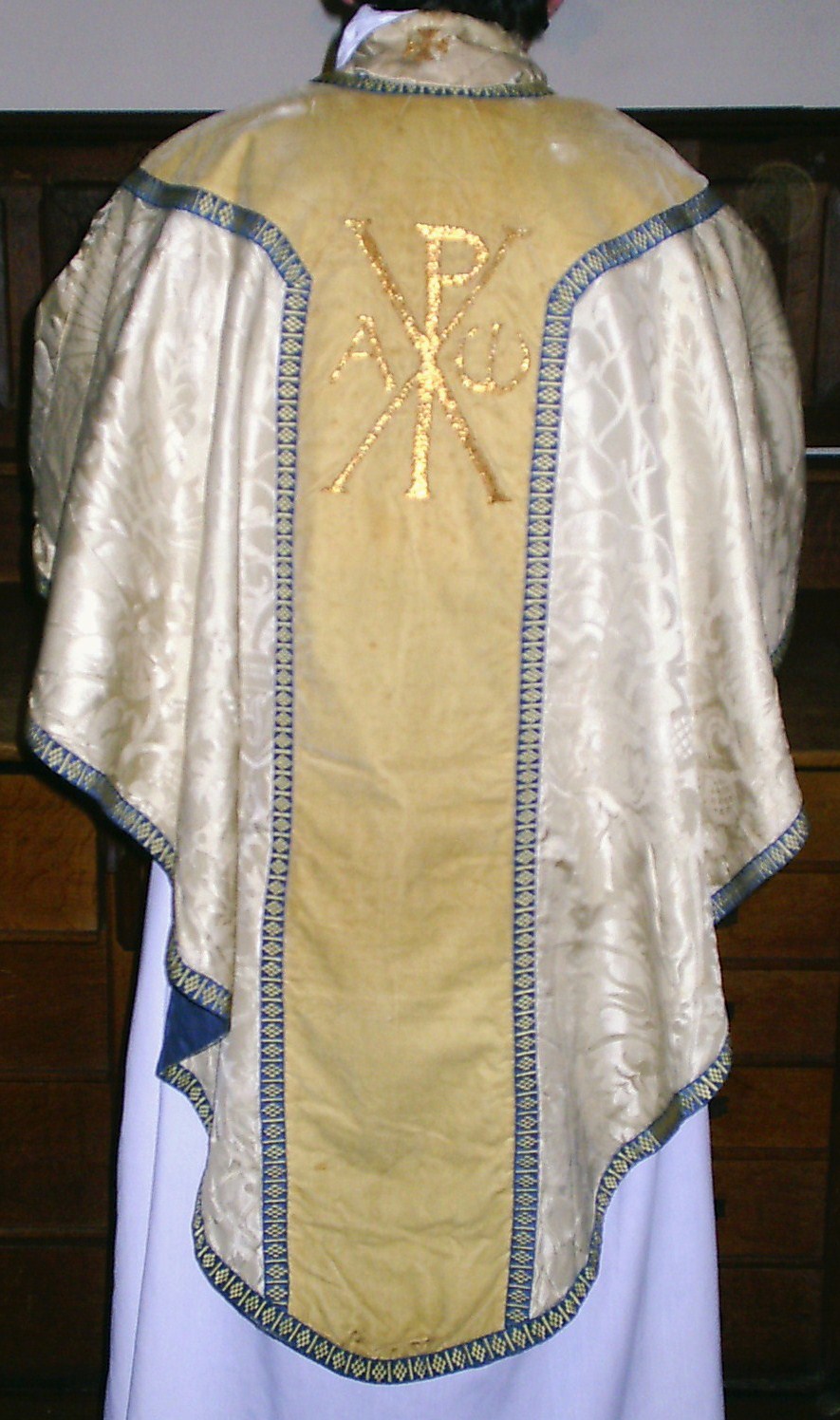
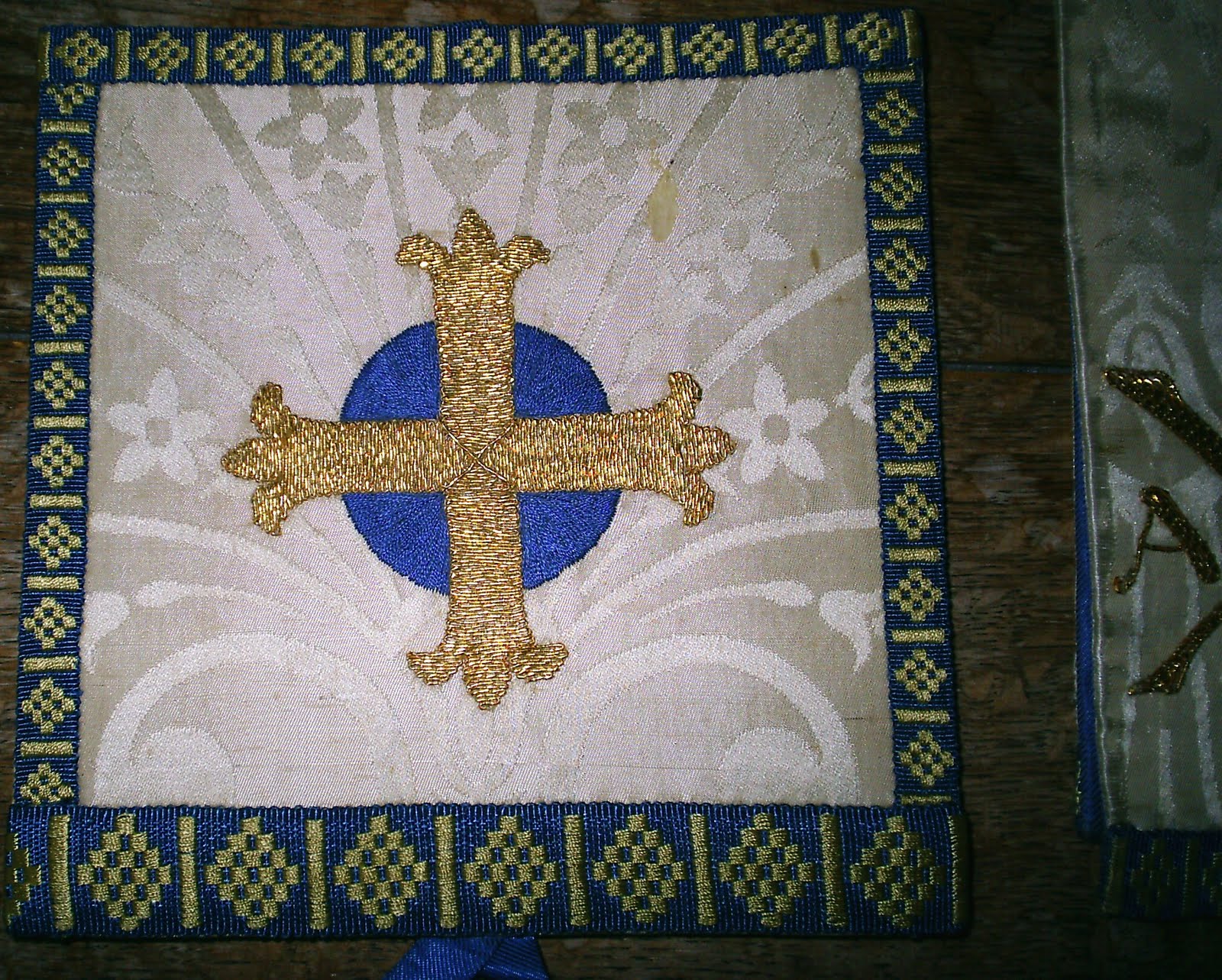
There are two extant white sets of vestments designed and used by Dr. Fortescue. Both sets have more of their constituent pieces than the violet sets of yesterday's post. The second white set below has a wide velvet silk orfrey (now showing some discolouration), a combination shared with several of the other vestments in the different liturgical colours. The detail in the orfreys of both sets is very fine and carefully designed.
The above is a photograph of the end of the maniple resting on the chalice veil. Note the width (and length from the photographs above) of the maniple. The second set, below, is showing signs of deterioration of the velvet column. Again note the length of the maniple and the stole.
The Chi-Rho decoration at the termination of the stole and maniple, and the cross on the burse are of embroidered gold thread.
The above is a photograph of the end of the maniple resting on the chalice veil. Note the width (and length from the photographs above) of the maniple. The second set, below, is showing signs of deterioration of the velvet column. Again note the length of the maniple and the stole.
The Chi-Rho decoration at the termination of the stole and maniple, and the cross on the burse are of embroidered gold thread.
Monday, 5 December 2011
The Vestments of Adrian Fortescue, DD. Part I
This month will see the launch of a new biography of one of the most brilliant yet enigmatic of English clerics, Dr. Adrian Fortescue. 'The Latin Clerk: The Life, Work and Travels of Adrian Fortescue' by Aidan Nichols OP and published by the Lutterworth Press should, hopefully, be an interesting read. Adrian Fortescue was a man of many, diverse, talents and there is a certain irony that the work which most readers of this blog will associate him with, The Ceremonies of the Roman Rite Described, was a work Fortescue deeply regretted writing and took little subsequent interest in. That in itself is rather sad as it is a most excellent work indeed.
Fortescue designed his own vestments in a singular yet characteristic style for use at his church of St. Hugh at Letchworth. Several years ago with a change of incumbent Fortescue's vestments were thrown away and piled onto a skip. Fortunately, some were spared the land-fill site and rescued from the skip by His Excellency Fra' Duncan Gallie and taken to St. Edmund's College at Ware, an institution with which Dr. Fortescue had many connections. Two years ago I was able to take some photographs of them thanks to the kindness of Mr. Alan Robinson. Several Low Mass chasubles, some complete sets, were saved along with a frontal of great interest but, sadly, no copes or High Mass sets survive.
As this is the season of Advent this first post will show the violet vestments. Two violet Low Mass chasubles remain. One has maniple, burse and veil the other only its stole. As the adage says 'a picture is worth a thousand words' let the vestments describe themselves.
Subscribe to:
Posts (Atom)