Wednesday, 28 April 2010

Octave Day of the Solemnity of St. Joseph


Today is the Octave Day of the Solemnity of St. Joseph Patron of the Universal Church. It is of greater double rite. The feast of St. Paul of the Cross this year is simplified to a commemoration by the occurring Octave Day.

At Mattins in the first nocturn the lessons are from occurring Scripture, in the second nocturn the lessons are a sermon from St. Augustine on marriage and concupiscence and the writings of St. Augustine again provide lessons on the Gospel of St. Luke for the third nocturn. The ninth lesson is of St. Paul of the Cross. (This is an example of when the contracted lesson, found for many feasts of nine lessons in the Pius X Breviary after the lessons of the second nocturn is used.)
At Lauds commemorations are sung of St. Paul of the Cross and St. Vitalis. Hymns of Iambic metre of course have the Paschaltide Doxology.

Mass is sung after Terce. The Gloria is sung, the second collect is of St. Paul of the Cross, the third collect of St. Vitalis. The Credo is sung, the preface of St. Joseph.

At Vespers a commemoration is made of the following Office of St. Peter Martyr and St. Paul of the Cross.

In the 'liturgical books of 1962' there is of course no Octave Day, no Octave and no Solemnity of St. Joseph. St. Paul of the Cross gets cut down from a feast of nine lessons to a third class feast. Mattins has one nocturn. The hymns of the Little Hours do not have the Paschaltide Doxology. St. Vitalis has been supressed. There are no commemorations at Vespers.

Sunday, 25 April 2010

St. Mark the Evangelist - Greater Litanies


Today is the feast of St. Mark the Evangelist and the day of the 'Greater Litanies'. The semi-double third Sunday after Pascha is out-ranked by the Double Second Class rank of St. Mark's feast.

St. Mark was particularly close to St. Peter. He is one of the Four Evangelists and is traditionally represented by a lion (as can be seen in the icon above) as it is one of the four beasts in the Prophecy of Ezechiel. St. Mark preached in Egypt and was martyred in Alexandria. The Greater Litanies, now associated with St. Mark's feast, have no real connection. In ancient Rome a procession was held on April 25th to celebrate the feast of Robigalia. This was later Christianised into the Greater Litanies. The Litany and Procession today is much older than the Rogation Days before the feast of the Ascension and the term 'Greater Litanies', as opposed to 'Lesser Litanies' reflects the greater antiquity and solemnity of the day. When a Procession cannot take place those with an obligation to the Divine Office are required to recite the Litany of the Saints.

At Vespers yesteray afternoon first Vespers of the feast were sung. The antiphons and psalms were taken from first Vespers of Apostles in Paschaltide. Commemorations were sung of the preceding Office of St. Fidelis of Sigmaringa and the Sunday. At Compline the Dominical psalms were sung, the Paschaltide Doxology being sung with Te lucis. The Dominical preces were omitted because of the occurring double feast (and being within an Octave).

At Mattins the invitatory, hymn, antiphon on the psalms of each nocturn are from the Common of Apostles. In the first nocturn the lesson are the Incipit of the Book of the Prophet Ezechiel, Et factum est trigesimo anno etc., from the Common of Evangelists in Paschaltide. The responsories are also from this Common. In the second nocturn lessons four and five are from St. Jerome on ecclesiastic writers, the sixth lesson is from St. Gregory's writing on Ezechiel. In the third nocturn the homily is from the Common of Evangelists along with the responsories. The eighth and ninth lessons may be read as one and the ninth lesson is of the commemorated Sunday. The three lessons of its homily, the Incipit of the Book of the Apocalypse may be read together as the ninth lesson, but only the first suffices for the obligation. The Te Deum is sung.

At Lauds the antiphons Sancti tui etc from the Common of Apostles are sung with the Dominical psalms (Pss. 92, 99, 62, Benedicite & 148). A commemoration of the Sunday is sung after the collect of the day.

At the Hours the hymns have the Doxology of Paschaltide. At Prime the festal psalms are sung (Pss. 53, 118i & 118ii).

Mass is sung after Terce. After the Vidi aquam the Mass, Protexisti, is sung. The Gloria is sung, the second collect is of the Sunday, the third collect of the Rogations (from the Mass Exaudivit). The Creed is sung, the preface is of the Apostles and the last Gospel is of the Sunday.

When the Procession takes place (for details read below) and there is only one Mass then the Mass Exaudivit is sung, celebrated in violet vestments. There is no Gloria, the second collect is of St. Mark, the third collect is of the Sunday. There is no Creed. The preface of Paschaltide is sung, the dismissal is Benedicamus Domino and the last Gospel is of the Sunday. (If a church is dedicated to St. Mark then the Mass of St. Mark is sung as above).

In Cathedral and Collegiate Churches two High Masses are celebrated today. After Terce has been sung the Vidi aquam is sung and the aspersion take place as usual on all Sundays. Mass is sung of St. Mark, the Mass is proper beginning with the introit Protexisti me etc. The Gloria is sung the second collect is of the Sunday, the Creed is sung, the preface that of the Apostles and the last Gospel that of the Sunday. Sext and None are then sung as usual.

The the altar frontal etc is then changed to violet and the Paschal Candle extinguished. The ministers vest in violet vestments, the deacon and subdeacon wearing dalmatic and tunicle respetively, the celebrant in a violet cope. A procession is formed to the altar. The crucifer and acolytes pass to the Gospel side. As the sacred minister arrive before the altar they make the usual reverence to the altar and choir and then kneel and pray for a short while. When they rise the cantors begin the antiphon Exsurge Domine. The choir continue....adjuva nos, et libera nos, propter nomen tuam. Ps. Deus auribus nostris audivimus patres nostri annuntiaverunt nobis. Gloria Patri etc, Sicut erat etc and then Exsurge Domine is repeated. All all kneel (except the crucifer and acolytes who go and stand at the entrance of the choir) and the cantors then begin the Litany of the Saints. This is sung in the full form, and not the shorter form used on Holy Saturday. Each invocation is doubled, i.e. the cantors sing e.g. Pater de caelis, Deus, miserere nobis and this is repeated in its entirety by everyone else. When Sancta Maria, ora pro nobis has been repeated all rise and the Procession sets off.

The Procession goes outside of the Church and may visit other Churches on its route. In this case the celebrant is offered lustral water at the entrance to the church and processes to the High Altar. After a moment for silent prayer the choir signs the antiphon of the patron of the church, its versicle and response (with Alleluia added as it is Paschaltide) and the celebrant sings the collect of the Patron. The Litany is then resumed and the Procession continues. If the Procession has a long route the Litany, from Sancta Maria etc may be repeated or the Seven Penitential Psalms sung to the tonus in directum. When the Procession enters the church where Mass will be celebrated, lustral water is received on entering and the Procession goes to the sanctuary. All kneel as the Litany ends. The celebrant intones Pater noster etc and then the cantors sing psalm 69. After the versicles that follow the celebrant stands to sing the ten collects. He then kneels again as Exadiat nos etc is sung. The ministers then rise and the celebrant changes from a cope to chasuble and all put on their maniples. The Mass Exaudivit is then sung. The chants are those used for ferial Masses. The Gloria is not sung, the additional prayers of the season, only, are sung. There is no Creed. The preface of Paschaltide is sung to the ferial tone, the dismissal is Benedicamus Domino. The Paschal Candle is not lit during the Procession and Rogation Mass.

The altar is then changed from violet to festal red and Second Vespers of St. Mark are sung. The antiphons for Vespers of Apostles in Paschaltide are sung with psalms 109, 112, 115, 125 & 138. The Office hymn is Tristes erant Apostoli which is sung of course with the Paschaltide Doxology. Commemorations are sung of the following Office of SS Cletus and Marcellinus and the Sunday. Compline is festal, Te lucis has the Paschal Doxology.

For those requiring more complex rubrics the feast of the Solemnity of St. Joseph, prior to the 1911-13 reform, was celebrated on this Sunday. The rubrics allow all Masses, with the exception of Conventual Masses, to be of the Solemnity of St. Joseph. The Mass Adjutor is sung, the Gloria is sung, the second collect is of St. Mark, the third collect of the Sunday and the fourth collect is of the Rogations. The Creed is sung and the preface is of St. Joseph. The last Gospel is of the Sunday.

In the 'liturgical books of 1962' St. Mark gets cut down to a mere commemoration at Lauds and Low Mass. The third Sunday after Pascha is celebrated but that too, of course, is cut down from three nocturns at Mattins to one. At Vespers there was no commemoration of St. Mark or of the preceding Office. At Compline the ferial psalms are used. At the Hours the Paschal Doxology is not sung. At Prime the Dominical psalms are sung. At Conventual Masses the Rogations are commemorated. When the Procession takes place the Litanies are not doubled the cantors sing e.g. Pater de caelis, Deus (only) and the choir responds Miserere nobis. At the Mass following the Procession all of the prayers at the foot of the altar are excised, even if the Mass is not of the Rogations. The Sunday is commemorated, the Creed is sung, the dismissal is Ite, Missa est. In Vespers of the Sunday there is no commemoration of St. Mark or the following Office.

Art: A Coptic icon of St. Mark from Wikipedia.

Thursday, 22 April 2010

Within the Octave of the Solemnity of St. Joseph

Within the Octave of the Solemnity of St. Joseph the Office of feasts of semi-double rank and above are celebrated in preference to the Office of Octave.

Today, the Office is of SS Soter and Cajus. The Paschaltide Doxology is sung at all hymns of the Little Hours. At Lauds a commemoration is sung of the Octave of St. Joseph. The Commemoration of the Cross is omitted because of the Octave. At Prime the Dominical preces are omitted because of being within an Octave.

At Mass the Gloria is sung, the second collect is of the Octave, the third collect is Concede nos. The Creed is sung because of the Octave and the preface is that of the Octave. Private Masses may be of the Octave of the Solemnity of St. Joseph with the Gloria, second collect of SS Soter and Cajus, third collect Concede nos, the Creed and preface of St. Joseph.

Vespers are from the chapter of the following feast of St. George with commemorations of the preceding feast of SS Soter and Cajus and of the Octave. The Commemoration of the Cross is omitted being in an Octave as are the Dominical preces at Compline.

(Of course, here in England where the Ordo is compiled Vespers are first Vespers of St. George Patron of England, where the feast is a Double of the First Class with Octave. Here the two Octaves overlap and are both celebrated - the Octave of St. Joseph being commemorated before that of St. George).

On Friday, St. George's feast, again the Paschaltide Doxlogy is sung at all hymns of Iambic metre. At Lauds a commemoration is sung of the Octave of St. Joseph. The Commemoration of the Cross is omitted because of the Octave. At Prime the Dominical preces are omitted because of being within an Octave.

At Mass the Gloria is sung, the second collect is of the Octave, the third collect is Concede nos. The Creed is sung because of the Octave and the preface is that of the Octave. Private Masses may be of the Octave of the Solemnity of St. Joseph with the Gloria, second collect of St. George, third collect Concede nos, the Creed and preface of St. Joseph.

Vespers are of the following feast of St. Fidelis of Sigmaringa with a commemoration of the preceding Office of St. George and the Octave of St. Joseph.

In 'the liturgical books of 1962' the semi-double feast of SS Soter and Cajus is cut down to a third class feast of three lessons. There is no Octave to commemorate. At Mass there is one collect. Vespers are said without any commemorations. St. George is reduced even further to a mere commemoration in the ferial Office.

Wednesday, 21 April 2010

The Solemnity of St. Joseph


Today is the Solemnity of St. Joseph Sponse of the Blessed Virgin and Patron of the Universal Church. It is a Double of the First class with an Octave. The feast was introduced into the Universal Kalendar by Pius IX in 1847 as the 'Patronage of St. Joseph' as a double of the second class to be celebrated on the third Sunday after Easter. In 1870 the feast was raised to a double of the first class and given an octave with 'Patron of the Church' added. In 1911 the feast was renamed the Solemnity of St. Joseph and became a primary double of the first class. In 1913 the celebration was moved to the Wednesday after the second Sunday after Easter. Although relatively modern the feast is a fine example of typology with the Patriarch Joseph being used as a 'type' of the foster-father of the LORD.

The feast began with first Vespers yesterday afternoon, described in the post below.

The Office is proper. At Mattins the invitatory is Laudemus Deum nostrum In veneratione beati Joseph, protectoris nostri, alleluia. The antiphons of the nocturns are proper and, as at Vespers, rather beautiful:

Angelus Domini apparuit in somnis Joseph, dicens: Surge, et accipe Puerum et Matrem ejus, et fuge in Ægyptum; et esto ibi, usque dum dicam tibi, alleluia.

Angelus Domini apparuit in somnis Joseph, dicens: Surge, et accipe Puerum et Matrem ejus, et vade in terram Israel; defunct sunt enim qui quaerebant animam Pueri, alleluia.

Consurgens Joseph, accepit Puerum et Matrem ejus, et venit in terram Israel; et habitavit in civitate, quae vocatur Nazareth, alleluia
.

In the first nocturn the lessons are from the book of Genesis and are extended in comparison with St. Joseph's 19 March feast. In the second nocturn the lessons are from a sermon on St. Joseph by St. Bernardine of Siena and in the third nocturn the homily is from St. Augustine on the Gospel fragment from St. Luke. At Lauds the antiphons from Vespers are sung with the Sunday psalms (92, 99, 62, Benedicite & 148). A commemoration is sung of St. Anselm.

At Prime the festal psalms (53, 118i & 118ii) are sung under the first antiphon of Lauds. At Prime and the Hours the hymns are sung with the Paschaltide Doxology.

Mass follows Terce and is proper, with the introit Adjutor. The Gloria and Creed are sung and the preface is that of St. Joseph. In private Masses a commemoration is made of St. Anselm.


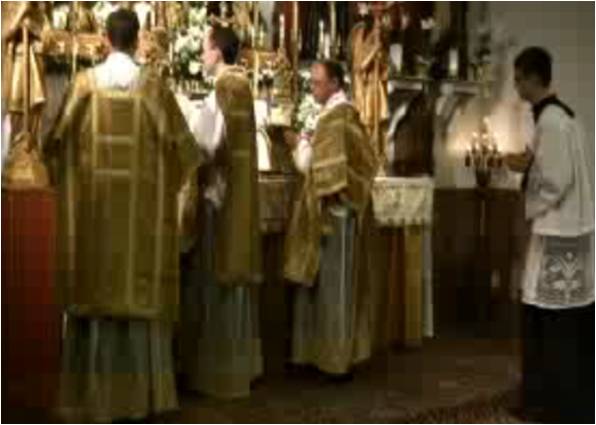
(A captured image from todays Solemn High Mass for the Solemnity of St. Joseph from St. Gertrude the Great Church in Ohio. The celebrant is reading the Gospel prior to its chanting by the Deacon. St. Gertrude webcasts daily at 16:20 BST)

In second Vespers a commemoration is made of the following Office of SS Soter and Cajus.

In the 'liturgical books of 1962' the Solemnity of St. Joseph simply does not exist as this beautiful feast was shamefully supressed in 1956. So,instead, St. Anselm is kept as a third class feast, without first Vespers, just one nocturn at Mattins etc. Even sadder the vast majoriy of those who consider themselves in some way attached to a form of usus antiquior are completely unaware of the feast's existence.

Interesting to see what happened to the Church after its Patron's feast was scrapped...

Tuesday, 20 April 2010

Tuesday after the Second Sunday after Pascha

The Office today is the ferial Office of Paschaltide. The day is of simple rite.

At Mattins the Paschal invitatory is sung. The psalms of the nocturn are sung under the antiphon Alleluia. The versicle Surrexit Dominus vere, alleluia is sung with the response Et apparuit Simoni, alleluia. The absolution is Ipsius pietas etc. The lessons are a continuation of the Acts of the Apostles (chapters 17 and 18). In place of a third responsory the Te Deum is sung. At Lauds the psalms are again sung under the antiphon Alleluia. The antiphon on the Benedictus is proper, the collect of the previous Sunday. The Commemoration of the Cross is then sung.

At Prime and the Hours the hymns are sung with the Doxology and tone of Paschaltide. At the reading of the Martryrology the first entry is the announcement of tomorrows great feast of the Solemnity of St. Joseph: Solemnitas sancti Joseph Sponsi beatae Mariae Virginis, Confessoris, quem Pius Nonus Pontifex Maximus, votis et precibus annuens totius catholici orbis, universalis Ecclesiae Patronum declaravit.

Mass is sung after Sext. The Mass formulary is of the previous Sunday. The Gloria is sung, the second collect is Concede nos, the third collect Ecclesiae or for the pope. The Creed is not said (it never is on days of simple rite), the preface is of Paschaltide.

Vespers are first Vespers of the great feast of the Solemnity of St. Joseph, Sponse of the BVM and Patron of the Universal Church. Where resources permit six pluvialistae in pariti assist the Hebdomadarius. The antiphons are sung with the psalms for Apostles and are particularly beautiful:

Jacob autem genuit Joseph, virum Mariae, de qua natus est Jesus, qui vocatur Christus, alleluia. Ps. 109 Dixit Dominus etc

Missus est, Angelus Gabriel a Deo in civitatem Galilaeae, cui nomen Nazareth, ad Virginem desponsatam viro, cui nomen erat Joseph, alleluia. Ps. 110 Confitebor tibi etc

Ascendit autem Joseph a Galilaea de civitate Nazareth in Judaeam, in civitatem David, quae vocatur Bethlehem, alleluia. Ps. 111 Beatus vir etc

Et venerunt festinantes, et invenerunt Mariam, et Joseph, et Infantem positum in praesepio, alleluia. Ps. 112 Laudate, pueri etc

Et ipse Jesus erat incipiens quasi annorum triginta, ut putabatur, filius Joseph, alleluia. Ps. 116 Laudate Dominum etc

The chapter is Benedictiones patris and the Office hymn Te Joseph celebrent agmina Caelitum. The antiphon on the Magnificat and collect are proper to the feast. At Compline the Domincal psalms are sung, Te lucis is sung with the Doxology of the tone of Paschaltide.

In the 'liturgical books of 1962' the Commemoration of the Cross is excised from Lauds. At the Hours the Paschaltide Doxology is not sung. At Mass there is one collect. At Prime there is no announcement of the feast of the Solemnity of St. Joseph as it was completely scrapped by Pius XII. More on that tomorrow. Vespers are of the ferial day.

Sunday, 18 April 2010

Second Sunday after Pascha


The Second Sunday after Pascha is sometimes referred to as 'Good Shepherd Sunday' from the words of the Epistle from I Peter "For you were as sheep gone astray: but you are now converted to the shepherd and bishop of your souls" and from the Gospel where the LORD proclaims "I am the good shepherd. The good shepherd giveth his life for his sheep." The Sunday is also often referred to as Misericordia after the opening words of the introit. The Sunday is of semi-double rite.

At Vespers yesterday afternoon the psalms of Vespers for Saturday were sung under a single antiphon, Alleluia. The chapter, Carissimi: Christus passus est pro nobis etc, was proper to the Sunday, the Office hymn was Ad regias Agni dapes. The antiphon on the Magnificat reinforced the theme of the Sunday, Ego sum pastor ovium. The Commemoration of the Cross was made after the collect of the Sunday. At Compline Te lucis was sung to the Paschal tone with the Doxology Deo Patri sit gloria etc and the Dominical preces were sung.

At Mattins the invitatory and hymn are sung as last Sunday. Again, at the nocturns the psalms are sung under one antiphon. In the first nocturn the lessons are from the Acts of the Apostles. In the second nocturn the lessons are taken from the first sermon on the Ascension of the Lord by St. Leo. In the third nocturn the homily is from St. Gregory. At Lauds the Sunday psalms (Pss. 92, 99, 62, Benedicite & 148) are sung under a single antiphon. The Office hymn is Aurora caelum purpurat. The Commemoration of the Cross is sung after the collect of the Sunday.

At the Hours the psalms are sung under an antiphon consisting of a triple Alleluia. At Prime the Dominical psalms are sung (Pss. 117, 118i & 118ii) as are the Dominical preces.

Mass is sung after Terce. The Gloria is sung, the second collect is Concede nos, the third collect Ecclesiae or for the pope. The Credo is sung, the preface is of Paschaltide.

Vespers are of the Sunday, with the psalms sung under a single antiphon. After the collect of the day the Commmemoration of the Cross is sung. At Compline the Dominical preces are sung.

In the 'liturgical books of 1962' the Commemoration of the Cross is excised from both Vespers and Lauds. The hymns at the Little Hours do not have the Paschaltide Doxology. The Dominical preces are not sung at either Compline or Prime. Mattins is slashed back to one nocturn. At Mass there is one collect only.

Art: Jerome Nadal

Thursday, 15 April 2010

Rubrics for Paschaltide

For all of Paschaltide, with the exception of the Octaves of Pascha, the Ascension and Pentecost, the psalms of each nocturn of Mattins are sung under one antiphon. In the ferial Office this is Alleluia and on feasts the first antiphon of each nocturn.

Likewise the psalms of Lauds, Vespers and the Hours are sung under a single antiphon.

On all ferial days the antiphon on the Benedictus and Magnificat is proper.

The Commemoration of the Cross is sung on semidoubles and lower ranking days outside Octaves. The structure of this commemoration is as follows:

Ant. Crucifixus surrexit a mortuis, et redemit nos, alleluia, alleluia.

V. Dicite in nationibus, alleluia. R. Quia Dominus regnavit a lingo, alleluia.

Oremus. Oratio
Deus, qui pro nobis Filium tuum Crucis patibulum subire voluisti, ut inimici a nobis expelleres potestatem: concede nobis, famulis tuis; ut resurrectionis gratiam consequamur. Per eumdem Dominum nostrum.

At Prime the festal Regi saeculorum is sung on all ferial days. In the short responsory the versicle Qui resurrexisti a mortuis, Alleluia, Alleluia is sung.

Apostles and Martyrs have their own Commons for Paschaltide. In other Offices Alleluia is added to the invitatory of Mattins, the antiphon of the nocturns and the versicles and their responses. A double Alleluia is added to the short responsories at the Hours and Compline.

At Mass two Alleluias are added to the Introit and in place of the Gradual after the Epistle a special Paschaltide Alleluia is sung consisting of two Alleluias followed by a verse and Alleluia and then a second verse and Alleluia.

(My, free style, translation of the rubrics in the Ordo, p.33)